EXPERIENCE DESIGN & UX STRATEGY
Turning customer research into a proactive Customer Success business model
A growing organization was underperforming. Customer Success operated reactively, leading to inconsistent engagement, rising churn risk, and untapped expansion opportunities. The business needed a customer strategy, not just account management.
THE CHALLENGE
Customer Success had a growing and diverse customer base, but no consistent framework for understanding or managing it. Despite strong demand, the lack of structure across the customer experience made it difficult to deliver consistent value or scale retention effectively. They didn’t need incremental improvements, they needed a system that drives retention and revenue predictably.
There was no shared view of:
Who different customers were
What they needed
What success looked like
Where Customer Success should invest its time
Which accounts represented growth or retention opportunities
The result was a largely reactive, one-size-fits-all approach.
THE TRANSFORMATION
The customer research and segments became a way to redesign how Customer Success operated. Instead of giving every customer essentially the same experience, each segment received a different level of investment, engagement, enablement, and support.
THE STEPS OF TRANSFORMATION
THE PROBLEM & THE OPPORTUNITY
The business lacked a shared understanding of their customers, regions and their businesses.
Customer Success was managing a diverse customer base without a consistent framework for understanding who customers were, what they needed, or how the business should serve them differently.
Without segmentation, customer management was largely reactive and one-size-fits-all—making it difficult to prioritize resources, drive adoption, identify opportunities, or scale the function effectively.
Create a research-backed customer segmentation and persona framework that could become the foundation for a more strategic and proactive Customer Success business model.
The goal wasn't simply to understand customers better, it was to use that understanding to change how the business served them.
THE APPROACH
RESEARCH
I started with conversations, research, and the people closest to the business—to empathize and gather all perspectives.
Before defining segments, I wanted to understand how the business currently saw its customers, and how the customers saw the business.
I worked closely with the Customer Success team and had conversations across departments, and customers to surface different perspectives.
Key questions:
Who are our customers?
Who actually makes the decision to partner with us?
Why did they partner with us?
Who influences that decision?
What challenges were / are they facing?
Who is responsible for implementing and managing the relationship?
How are they adopting the program?
What capabilities did they have internally?
How are there needs changing?
Who actually uses the program?
What does each group need from us?
Why do they choose us?
What makes them successful?
What gets in the way of adoption?
Where are we creating value, and where are we creating friction?
I combined those internal perspectives with customer conversations, market research, account and financial data, adoption analysis, and customer feedback to identify the patterns that mattered.
The research included feedback from customers on why they originally partnered and their top market challenges, alongside an adoption assessment across all accounts.
It was to create a shared understanding of the people within the customer ecosystem, and what that meant for how the business should operate.
Understanding the Customer Ecosystem
Before segmenting the customer base, I mapped the different roles involved in the relationship.
Users
Implement, build, solve problems, drive value.
Property Manager
Assistant Property Manager
Reservations Agent
Guest Services Representative
Front Desk / Concierge
Marketing Coordinator
Social Media / Content Manager
Website Administrator
Guest Communications Coordinator
Operations Coordinator
Influencers & Stakeholders
Shape decisions, provide expertise, remove roadblocks.
Property Management Director
Operations Manager
Revenue Manager
Marketing Director / Marketing Manager
E-commerce / Digital Marketing Manager
Reservations Manager
Guest Experience / Guest Services Manager
Business Development / Partnerships Manager
IT / Technology Manager
Website / Digital Experience Manager
Regional Property Manager
Buyers & Decision Makers
Authorize, sponsor, allocate budget.
Property Owner
Owner / Asset Manager
Director / VP of Operations
General Manager
CEO / Founder, for smaller vacation rental management companies
Regional / Portfolio Director
SEGMENTATION FRAMEWORK
From research to segmentation
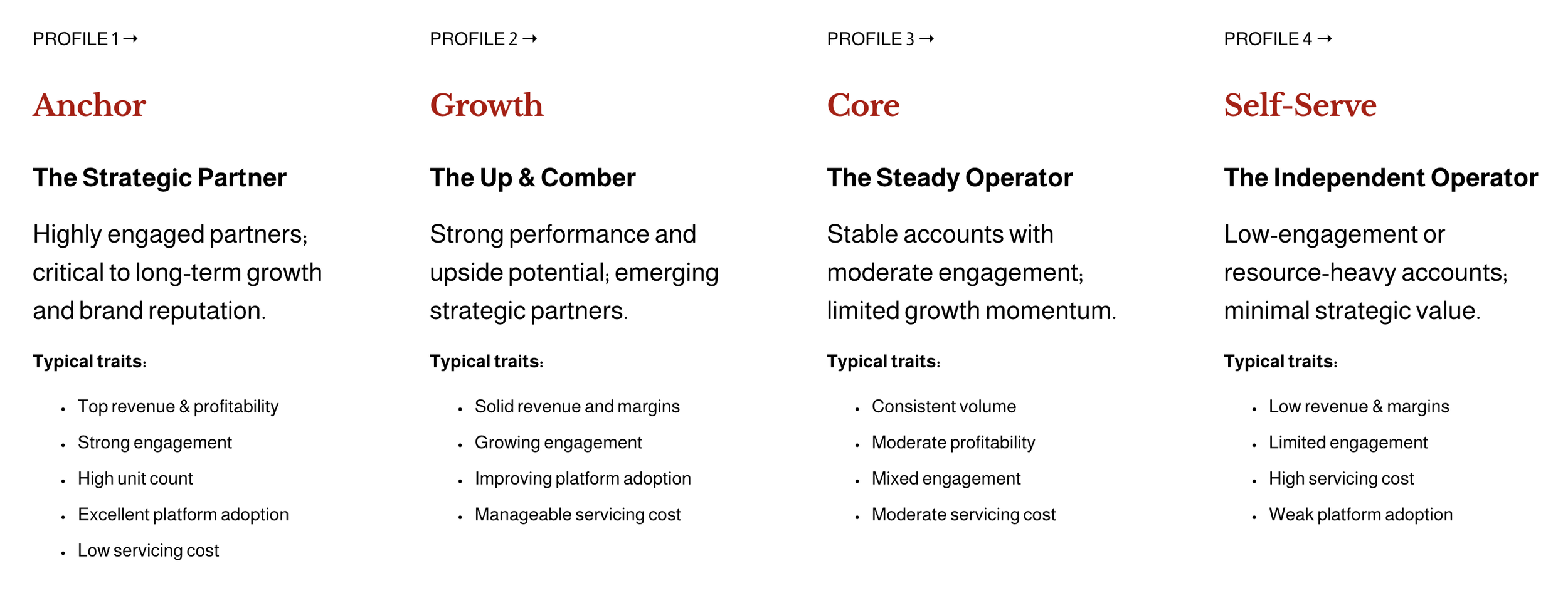
The research revealed meaningful differences in commercial value, profitability, scale, engagement, adoption, and servicing needs. Four customer profiles emerged.
PROFILE 1 →
Anchor
The Strategic Partner
Highly engaged partners; critical to long-term growth and brand reputation.
Typical traits:
Top revenue & profitability
Strong engagement
High unit count
Excellent platform adoption
Low servicing cost
PROFILE 2 →
Growth
The Up & Comber
Strong performance and upside potential; emerging strategic partners.
Typical traits:
Solid revenue and margins
Growing engagement
Improving platform adoption
Manageable servicing cost
PROFILE 3 →
Core
The Steady Operator
Stable accounts with moderate engagement; limited growth momentum.
Typical traits:
Consistent volume
Moderate profitability
Mixed engagement
Moderate servicing cost
PROFILE 4 →
Self-Serve
The Independent Operator
Low-engagement or resource-heavy accounts; minimal strategic value.
Typical traits:
Low revenue & margins
Limited engagement
High servicing cost
Weak platform adoption
THE SHIFT
The profiles became a way to redesign the customer experience, and shift how Customer Success operated
Instead of giving every customer essentially the same experience, each segment received a different level of investment, engagement, enablement, and support.
The research also revealed that customer priorities were changing. This helped shift Customer Success conversations away from simply "Are you using the program?", toward "What business outcome are you trying to achieve, and how can we help you get there?"
Different customers, different strategies:
PROFILE 1 →
Anchor
The Strategic Partner
High-touch partnership
Strategic planning
Executive engagement
Custom collaboration
PROFILE 2 →
Growth
The Up & Comer
Growth-focused support
Targeted enablement
Adoption improvement
PROFILE 3 →
Core
The Steady Operator
Intentional support
Standard onboarding
On-demand resources
PROFILE 4 →
Self-Serve
The Independent Operator
Scalable support
Self-service resources
Lower-touch engagement
THE OUTCOME
From reactive account management to a proactive, segmented Customer Success model for scale
Segmentation is only valuable when it changes what a business does, and I don't create personas simply to document who customers are.
I use research to uncover the patterns that should influence:
Who we serve
How we serve them
Where we invest
What experience we create
How we measure success
How the business grows
I built the customer experience and strategy that didn't exist:
Customer Journey
Onboarding → Adoption → Optimization → AdvocacyAccount Segmentation
Different customers → different strategiesCustomer Profiles
Clearer needs, value drivers, and opportunities
Service Models
Different levels of engagement and investmentEnablement
Resources connected to customer needs and business outcomesReporting & Measurement
A clearer way to understand adoption, health, and value
Let’s talk about what you’re trying to solve.
I take a small number of new engagements each year. If your challenge sounds like the work above, I’d love to hear about it.