EXPERIENCE DESIGN & UX STRATEGY
User segmentation and persona-based strategy to refocus a horizontal SaaS business.
Reframing a complex form development and business process automation platform around the people who buy, use, adopt, and ultimately determine the value of the product.
THE CHALLENGE
The platform was focused on form development and business process automation. It intended to enable organizations to build forms, automate workflows, connect data across applications, and create reports and visualizations. We had a powerful product, but we didn't have a shared understanding of who it was for, and as a result our customers struggled to realize value, and renewal was always a risk.
THE TRANSFORMATION
The personas weren't the deliverable. This work shifted the conversation from personas to business alignment. The real value was giving the business a shared way to understand its customers, and to use that understanding across the SaaS lifecycle.
THE STEPS OF TRANSFORMATION
Problem Definition & Opportunity →
Approach: Customer Ecosystem →
Approach: Segmentation Framework →
Outcome →
PROBLEM DEFINITION & OPPORTUNITY
The business lacked a shared understanding of who the product was for, how it created value, and how to connect the right people to that value.
The product had largely been designed and built by technical people, while the majority of the people we needed to use it were not developers. The experience was complex and often difficult for non-technical users to understand without significant support.
The problem wasn't just adoption, it was alignment.
THE OPPORTUNITY
Align understanding across the business at every step of the customer journey and the product experience.
From what it did, who it was for, who should buy it, who should use it, what problems it solved.
Sales: didn't have a clear understanding of who they were selling to.
Solution Engineering and Customer Success: had to do significant work to explain, onboard, and train customers.
Product: lacked a shared understanding of the different people and use cases the platform needed to support.
Everyone had a different view and understanding of the product
01
We had a disconnected value story that led to a prolonged sales cycle, underperforming pipeline, and constant renewal risks that consumed resources.
Sell to executives: Users don't adopt → Value is difficult to realize →Renewal is at risk
Sell to practitioners → Executives don't see strategic value → Strategic impact is unclear → Renewal is at risk
Disconnected value story in sales and customer success
02
APPROACH
CUSTOMER ECOSYSTEM
I started by looking into the people—not the product.
The goal wasn't to create another set of marketing personas. I wanted to understand the entire ecosystem of people involved in buying, adopting, using, and getting value from the platform.
I combined customer research, external research, stakeholder interviews, existing go-to-market documentation, competitive research, and product data to develop a shared view of the customer and user ecosystem.
Key questions:
Who buys?
Who influences?
Who implements?
Who actually uses it?
Who needs to be enabled?
Who demonstrates value?
Who decides whether to renew?
Key findings:
The person who buys the platform isn't necessarily the person who uses it.
The customer is an ecosystem, it’s not just one persona.
The strategy needed to connect them all.
Users
Implement, build, solve problems, drive value.
Business Users
Citizen Developers
Technologists
Engineers
Influencers & Stakeholders
Shape decisions, provide expertise, remove roadblocks.
IT Leaders
Solution Architects
Operations Leaders
Change Champions
Buyers & Decision Makers
Authorize, sponsor, allocate budget.
Business Leaders
Executives
Risk & Compliance
Finance
SEGMENTATION FRAMEWORK
Understanding the people behind the product
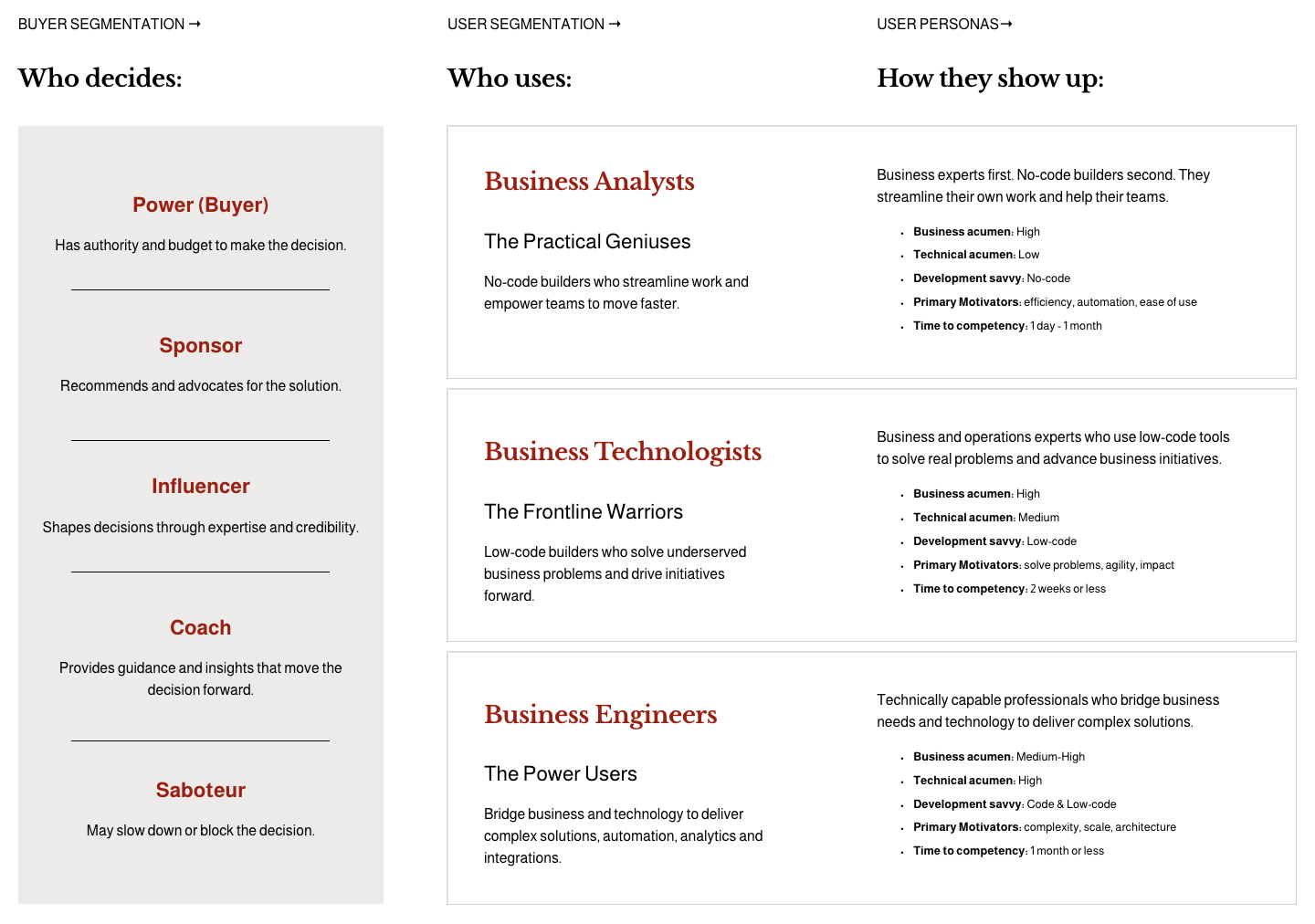
Three core user segments were identified. The segmentation was based on business acumen, technical acumen, development experience, motivations, and use cases. The goal was to move from, "Who is our customer?" to, "Who is using the platform, what are they trying to accomplish, and what do they need to be successful?"
BUYER SEGMENTATION →
Who decides:
Power (Buyer)
Has authority and budget to make the decision.
Sponsor
Recommends and advocates for the solution.
Influencer
Shapes decisions through expertise and credibility.
Coach
Provides guidance and insights that move the decision forward.
Saboteur
May slow down or block the decision.
USER SEGMENTATION & PERSONAS →
Who uses & How they show up:
Business Analysts
The Practical Geniuses
No-code builders who streamline work and empower teams to move faster.
Business experts first. No-code builders second. They streamline their own work and help their teams.
Business acumen: High
Technical acumen: Low
Development savvy: No-code
Primary Motivators: efficiency, automation, ease of use
Time to competency: 1 day - 1 month
Business Technologists
The Frontline Warriors
Low-code builders who solve underserved business problems and drive initiatives forward.
Business and operations experts who use low-code tools to solve real problems and advance business initiatives.
Business acumen: High
Technical acumen: Medium
Development savvy: Low-code
Primary Motivators: solve problems, agility, impact
Time to competency: 2 weeks or less
Business Engineers
The Power Users
Bridge business and technology to deliver complex solutions, automation, analytics and integrations.
Technically capable professionals who bridge business needs and technology to deliver complex solutions.
Business acumen: Medium-High
Technical acumen: High
Development savvy: Code & Low-code
Primary Motivators: complexity, scale, architecture
Time to competency: 1 month or less
THE SHIFT
The personas were not the deliverable
The real value was giving the business a shared way to understand its customers—and use that understanding across the SaaS lifecycle. The segmentation provided a foundation for prioritizing product and user experience decisions around real user needs and use cases.
From this, to that:
Sales
Who can we sell to?
Who are the different people involved in the buying decision, and how do we connect their needs?
Solution Engineering
Here’s everything the platform can do.
Here’s what the platform can do for you.
Customer Success
How do we train customers to use the platform?
What does this specific user need to become successful?
Product
How do we make a complex technical product easier to use?
How do we design around the people actually using it?
Education & Enablement
How do we teach everyone the platform?
What does each user need to know to accomplish what they came here to do?
Marketing
Here’s what our platform does.
Here’s how our platform can help you solve your problem.
One product, multiple experiences.
One platform.
Executive
Why should we invest?
↓
Business Leader
What problem can this solve?
↓
Business Analyst
How can I make my work easier?
Business Technologist
How can I solve this problem?
Business Engineer
How can I solve for this complexity?
↓
One connected value story.
THE OUTCOME
The work shifted the conversation from personas to focus and business alignment
I brought together experience design, UX strategy, product thinking, customer insight, learning and enablement, and business strategy to create a segmentation and persona framework that could be used across the organization.
The goal wasn't to create personas that sat in a presentation.
It was to create a shared understanding of the people behind the product, and use that understanding to refocus how the business approached Product, UX, Sales, Solution Engineering, Customer Success, Education, and Adoption.
The segmentation framework created:
A SHARED LANGUAGE FOR UNDERSTANDING
Who we sell to
Who uses the product
Who needs to be enabled
What each audience needs
How people reach competency
How adoption creates value
How that value gets back to the executive decision-maker
THE FOUNDATION FOR CONNECTION
Sales: Who do we sell to?
Product: Who are we designing for?
Solution Engineering: Who are we demonstrating to?
Customer Success: Who are we onboarding?
Education: Who are we teaching?
Leadership: How does success create business value?
CLARITY ON REFRAMING THE CHALLENGE
“How do we get people to use our product”?
to…
“How do we create an experience and business model that makes it easier for the right people to understand, adopt, use, and demonstrate the value of our product?”
Let’s talk about what you’re trying to solve.
I take a small number of new engagements each year. If your challenge sounds like the work above, I’d love to hear about it.